


 I was watching a dear friend and teacher recently speak on a Facebook Live broadcast about how change is not comfortable, and about how we are using that as an excuse not to change.
Well... my dear friend, I have to disagree on a couple of finer points:
1. The reason most people need and desire change is because their comfort zones are no longer comfortable.
2. When the change one is seeking begins to happen, we feel excitement--not discomfort.
She also spoke about how the process of changing steers one through all the barriers, reasons, sensations and blockages that are holding the particular condition or situation we wanted to change in place. It's true that all of this unraveling can temporarily feel like things are "falling apart", or "caving in", however, if the intention was to change, this unraveling is the evidence validating the intention to change, so why not celebrate it?
Yes, we can definitely lose track of all the changes we have desired, so that all this "falling apart" seems dangerous or distressing--and if we go into being the victim, we risk the nullification of our intention to change.
In fact, most desire to change revolves around finding a comfort zone, where life comes to us with ease and joy, and we are free to express ourselves creatively, experience the world as a loving place, and where future changes are joyful and generative.
I would hazard a guess that the meme, "Change is uncomfortable" is really just an arbitrary point of view that ignores the mechanics of how things work in this magical 3-D world we've constructed. The bottom line is that the higher more generative life we seek change for, is, in fact, the truer reflection of who we really are. And to make that change, we have simply to focus our intent on that version of ourselve already existing as a parallel reality.
I would also profer the view that what drives most change is discomfort or pain of some level, and that it is impossible to change from an alleged "comfort zone". If we are truly in this theoretical comfort zone, why would we want to change from that?
On the other hand, why experience discomfort at all in a "comfort zone"? How about just choosing something different--perhaps with more magic, excitement and incredibleness?
If instead, we are suffering or prolonging discomfort, how about changing the current situation or condition by tuning in to the higher version of yourself, and sending out the intention to become that? More joy, more ease, more fulfullment, more amazing-ness. Then, be willing to experience whatever the universe presents to us as experience in the unfoldment of that version of yourself wherever it may lead.
 I would also venture to make the observation that behind all discomfort and pain is the desire for that higher version of your life, and that any pain or discomfort we are experiencing is us in the process of actualizing that higher life. It's the perception that life is victimizing us that prolongs the discomfort, pain and suffering, and potentially completely blocks any change.
So switch it up. Be the creator. Spot where the victim is, and simply say "bye bye". Then go to where the ease and joy is that will demonstrate to the Universe--your co-creative partner--that you are onboard with realizing the greatest life you can experience, and that you are willing to go beyond that. Continually broadcast that vibration of ease, love and joy, and tune in to that same broadcast emanating from the Ultimate You right next door. Enjoy the ride, and enjoy arriving at your new comfort zone!


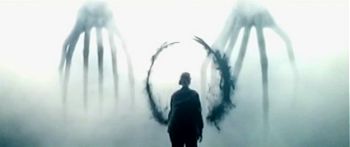 One of my favorite authors and and shamans (although he wouldn't admit to being one), is Terence McKenna. Mainly famous for his ascendancy as the progenitor to Timothy Leary, McKenna made it his mission to enlighten his audiences about the very deepest fact no one talks about: our world is made of language.
 One of the exercises I was taught by my guru many years ago was the practice of non-duality. In this practice, we try to see the world and our experience of it as a whole system containing both ends of a spectrum or duality. Say we witness what appears to be a cruelty in the world. The non-dual approach would be to simultaneously notice the kindness resulting from the cruelty. We try to see hate as a cry for love; a judgment as a desire for something greater. After practicing this for awhile, you come to a place where language seems limiting--indeed a "weapon" of limitation, secrecy and control.
 One of the most basic skills in magic is to entrain the audience into suspending their disbelief of their own senses. If the audience no longer disbelieves what they are seeing, what you do as a magician seems like real magic. The trick is to convert the skepticism of disbelief into the wonder of true believing.
 I was out on my daily walk the other day, and my eye was riveted by these tiny flowers whose plant was draped enticingly over some river rocks in a wall. Unexpectedly, as I admired these precious flowers, I was overcome with emotions of beauty, poignancy and reverence.
 in the ancient practice of non-duality, the perception of "opposites" is discovered to be a manufactured point of view that we use to define and separate groups of things from other groups of things. Apparently, this is for the purpose of playing a game, or, more basically, having the ability to perceive: without dark, there is no light; without vacuum there is no form; without ignorance there is no knowing; without forgetting, there is no remembering; et cetera, et cetera.


 One of the more amazing aspects to Life that quantum physics teaches us is that all possibilities--infinite possibilities--exist within every moment. We also learn that the subatomic intelligences making up the perceivable universe(s) are clumped together in forms that the mind assigns use and meaning. These subatomic intelligences are listening to our thoughts and watching our actions at every moment.
 How do you stay in the question? The key is mindfulness. We must be able to observe the moment we "double-down" with a conclusion or point of view. For example, your employer passes you up for a well-deserved promotion. The conclusion? "It's unfair!" or "I'll never get anywhere at this place", or "I guess I'm just not worthy". Instead, ask the question, What else is possible? What about this is getting me to my greatest and most glorious life?
 At 80 years old, Robert Redford plays a scientist who proves the existence of the Afterlife, so kudos to him for taking on this age-appropriate Netflix production.
 The cadaver tells a mind-blowing tale, which gets me to why this film had such an impact on me, as a quantum physics buff. (Spoiler Alert) Via a quivering and ghostly video image from the cadaver's point of view, we see a known local hospital where the subject visits a family member. At first, everyone thinks the video feed is simply a string of memories, which would invalidate the premise that the machine retrieving this video is plugged into the subject's current view of the Afterlife.
 A somewhat shocking explanation given by engineers about how quantum computing works, is that all mathematical problems have been solved in all parallel universes. Inform a particle in this universe of a problem, and it automatically retrieves the solution from a parallel universe. In other words, quantum particles travel among parallel universes instantaneously, and those particles are what make up our very own lives.
 I've always been a big Carlos Castaneda fan, and his semi-fictional books have always been an inspiration. Now and then I revisit some of that information, and one piece in particular kept leaping into my awareness this past couple of weeks.
 What we can create--and create in an instant--is an awareness of one of my favorite concepts: "Pronoia": The feeling and observation that Life is working in your favor. If you can perceive circumstances as being to your advantage, no matter how extreme or disadvantageous, then you've begun to "lead the pack".