Showing posts with label mindfulness. Show all posts

Monday, June 17, 2019

Mindfulness and the Status Quo

mindfulness I ran across an article about mindfulness the other day that kind of boggled my mind with its oversimplicity, snarkiness and, well, rudeness. The author was attempting to make an argument that the current popularity of mindfulness practices is re-inforcing the economic and social status quo, denying social injustices, and is creating a world full of self-centered, passive magical thinkers.

It was like watching someone who has no idea what a football is, lay out an elaborate critique about the football not being round.

This writer had decided that if everyone spent their lives watching their thoughts without judgment, nothing would get changed in the world because there would be no reason to change anything, as if judgmentalism and victimhood were pre-requisites to social change.

He was also writing from a trolling position of "those mindfulness people", obviously without having ever done the practice. I would like to point out to this unfortunately misinformed critic that the practice of mindfulness is probably the world's best hope for survival.

If all the world's leaders were able to sit together in mindful non-judgment about the state of the world, wouldn't you think things would change, not only politically, but economically as well?

Being in non-judgment doesn't mean to stop caring about injustices, prejudices, and "evil" in the world--on the contrary, non-judgment comes from a place of non-duality, where the naked truth of a situation can be revealed in all its ugliness or beauty. From there, the mindful person can then make a choice as to what is desired in one's personal life and the world at large.

The other vital characteristic of mindfulness is becoming aware of one's personal dark side--the habitual monkey-ninded diatribe of negativity that pulls a person into depression, hopelessness and apathy. By observing such automatic thoughts and feelings without judgment, they can be seen for what they nearly always are: a cry for love. By acknowledging these thoughts and feelings, it reduces their frequency, neutralizes their power, and reveals the trauma and hurt crying out for a loving embrace.

Another argument was centered around being "happy" with any negative situation, so that the mindful person has no motivation to change anything. This just points up the author's ignorance of the practice. Remember that "Kung Fu" TV episode when Cain is put in jail? He sat down and went into meditation, becoming hyper-aware of his surroundings, he was then able to find a way to harmlessly break out of the prison. This is what mindfulness provides: a way to use the mind to look at all aspects of a situation--without denial, without judgment--so that all perceptions and powers can come to bear on a problem.

The author also had a problem with the meme, "Happiness is an inside job", as if a person can only achieve happiness by controlling outside circumstances. This, of course, is backwards. By "being OK" with one's predictament is not saying they are satisfied with it. The "being OK" means that all facets of a situation--both positive or negative--can be observed with equanimity and then intelligent choices made to change or not change it. Personally, if I'm experiencing a negative circumstance, I would much rather "get my mind right" about it by achieving peaceful allowance of it so that all the possibilities for action can be considered. Otherwise, I'd just be throwing my fists wildly in the air in hopes of hitting something--and I've been there, believe me!

Mindfulness is a vital practice, and anyone who says different is advocating for self-ignorance, low intelligence, and warlike approaches to the world's problems. It is important to allow that many people do have these non-mindful views, because by being OK with them allows us to see the pain and injustices that must have been at their genesis.

Friday, April 5, 2019

Living in Possibility

possibility Have you had this experience? You wake up in the middle of your sleep cycle, and suddenly everything about existence makes sense, and meaning washes over you in a timeless wave of knowing. You are caught up in a cosmic moment of understanding and feel suspended in time and space with your whole life laid out in front of you like a three-dimensional mandala. Well, this happened the other night, and, of course, upon officially waking up later, I had trouble remembering the dream and the experience. But it returned slowly over the last couple of days.

As I contextualized the experience, it became about living in the unknown, but completely without fear, knowing everything was in its right place and correct time. The tendency, when confronted with uncertainty and larger unknowns is to start doing what's been called "predictive processing" with the mind. This takes the form of worry, or obsessively computing and conjuring outcomes based on known data. It's actually a bad habit, because when actual outcomes start showing up, nine times out of ten, they are nothing like what was computed. Yet, for some reason, we keep doing it--probably from a sense of disempowerment and a feeling of being out of control, where at least you can control your imagination by creating scenarios.

Deep down in the behaviorial DNA there's a gaping fear of not being, and I think what we may think of as a terror of the abyss or void, is actually excitement about infinite possibility. Excitement and fear have been shown to fire up the same neurons in the brain, and most of what goes for fear of the future is learned. This lies outside the purview of a perceived existential physical threat, but we tend to lump anything "unknown" into a threat, hence the fear of the future.

The irony is that, as non-physical entities, we cannot NOT BE, but the over-identification with our personas, body, and other identity markers we use to interact with others sets us up for "losing it all" or just plain "losing it". Now, I've been there a few times in my life, and it really seemed real at the time, and for some time after that, but as events sauntered on and perspective was gained, I can look back on these "losses" as necessary wisdom teachers.

As I have begun to embrace this "living in the unknown", I have started to re-frame it as "living in infinite possibility." The habitual tendency of the mind and emotions to worry has now become a signal to observe how past perceived traumas have left their mark and sculpted a terrain of avoidance--much like keeping your hand away from a flame, or not moving when in pain. These areas of avoidance get activated when circumstances appear threatening due to perceived lack of information. I have started to simply let all that go, and instead embrace the excitement of not knowing what wonderful infinite possibilities are precipitating all around me to become gloriously visible at some point.

Along these lines, I've been experimenting with spending money--a big area of past trauma for me--and have started to notice that everytime I would spend, say, 50 bucks for groceries, 50 bucks of income would shortly show up--within a few hours or days. In two cases, the amounts were nearly exact, which made me start looking at this in the first place. I had no idea beforehand where these monies would be coming from, and in most cases, when I am scanning for sales or income sources, I'm completely surprised about what shows up instead.

possibility By letting the unknown be unknown, it takes the limitations off of what is possible. Just declare it: "Show me something amazing", or "I don't know or care how, just show up!" and then remain mindful in the moment, observing the coalescence of events and circumstances as they unfold to answer your intent.

I've also noticed that worrying doesn't seem to have any affect one way or another on the manifestations. The problem with worry is that it is a way of stressing the body and is debilitating. It's better to re-frame worry into excitement or curiousity, spot the past trauma, observe it, and then remain mindful in the present. The sage and I Ching master, Wei Po Yang, when asked about what he had learned from a lifetime of studying the I Ching, said, "To worry is preposterous." Why would he say this? Because all of life is in support of being, and only when we cut ourselves off from that support by low self-esteem or self-destructive programming, do we repel that support.

Life makes life, and even death makes life, so either way, you're gonna be alive one way or another. Why not accept the excitement, the support, and the love we all have inherent in being?

Tuesday, December 18, 2018

De-constructing the Bureaucracy of Self

Humans are funny mammals--funny tragic, that is. At our core we are infinite spiritual beings, and by the time you zoom in through all the levels of power dissipation, we're left with individuals with tragically limited personal power, separated and compartmented into a matrix of beliefs about who and even what we are.

I've been stepping up time spent in clearing meditations (see Two Tools), and as I shoveled on through what sometimes seems like miles of decisions, judgments, conclusions, choices and self-evaluations, the image of a huge bureaucracy came to mind. And this huge bureaucracy was making up who I think I am, or have been.

Let's see. We have The Shoulds Department, where I can wallow in suffering because things should be different--as if that's going to change anything. But it's great for copping out and not confronting the truth of a given situation.

Then there's The But Department. Here we have the thousands of employees that immediately yell out, "BUT" when any idea that might lead to more freedom or personal power is broadcast. This is designed to maintain the status quo so there is no failure should the idea actually attempt fruition. After all, the worst BUT of all springs from the fear of failure or success.

Ah, yes. The Conclusion Department. This is the shut-off valve for practically any access to infinite possibilities. I can search for answers here, and this department will spit out the immediate reasons why such and such is true. For example, I can ask, "Why is my bank account so depleted this month?". A typical answer from the Conclusion Department is, "You didn't work hard enough," or, "The economy is down overall, globally, so that's why." Oh, okay. So I'll work more hours doing what I've always done. Ugh.

And, my favorite: The Judgement Department. Here I can dependably find all the self-evaluations, conclusions about others' behaviors, my body appearance, and of course, all the "hard data" about how I've messed things up, and how I could have done that better, but will never do it. Here I can cop out of trying to access any personal power, because, well, you know, I just don't have what it takes, I'm not good enough, and it's too much work, and no one cares anyway about what I have to say, or what I do.

We are complex beings. In fact, it is our complexity that limits us. We make things so complicated when we consider our infiniteness, our immediate access to total freedom, and our direct connection to Universal intelligence, that it looks like an impossibility that these desirable states are actually attainable.

We dumb ourselves down in order to conform to a set of arbitrary rules and laws. Why? To discover our infiniteness and our total freedom, apparently. The funny tragic thing about that is we can choose to break out of the bureaucracy of self and relatively immediately find ourselves shining like a star in Universal Oneness, unencumbered by the box we have called "life".

Wednesday, October 17, 2018

Riding the Waves of Feeling

inner light I woke up this morning, and besides my normal waking fog, as I sat on the edge of my bed, there was some familiar terrain of feeling down deep. It was familiar in the sense of it seemed ancient and something I hadn't felt for a very long time. It was soft, powerful, all-encompassing and poignant--as if I had just arrived back home after a long absence.

This particular feeling persisted, and as I went on with my day, I noticed that almost everything I looked at, every smell, every sound, was triggering feelings I'd felt as a child, or at different times in my life--sometimes cascading with four or five opisodes firing at once. These have been intense enough to bring me to a complete pause, motionless, simply being and experiencing these intense messages from beyond, or unburied from deep within.

Many of these feeling phantasms were melancholy and brought about reactions of futility and sadness. As these continued to wash through me, I realised there was a juicy counterpart at the other end of this feeling spectrum: futility could be felt as high hopefulness; sadness could be felt as poignant joy. It became a matter of simple choice as to which end of the spectrum of these feelings I could feel.

For want of a better analysis, it would seem I've stumbled upon a kundalini event, where suddenly new spaces, new vistas of possibility have been revealed, and the gateway to these possibilities seems to have been flung wide open.

Lately, there have been astronomical reports about the sun's heliosphere contracting along with the solar minimum. The contraction of the heliosphere allows high-powered and high-velocity cosmic rays from galactic center to more easily penetrate the boundary between the heliosphere and our solar system, bringing new types of radiations to our planet. These have been shown to directlyl affect human consciousness.

Whatever it is, something is going on, and it's being felt by humanity either consciously or unconsciously, bringing a multitude of opportunities for all of us to explore the multi-dimensional aspects of our being. There is so much about ourselves that has been obscured, cut off, and made invisible for the sake of incarnation, cultural control and constriction of our senses and abilities.

When we begin to access previously shutdown perceptions and pathways to high abilities, it feels like a coming home, or a re-centering of being, just on the verge of overwhelming, yet completelly natural. It is the Second Coming of the Self, the beginning of an embodiment of everything that is.

Ask for it. Reach for it. It is there, and say hello to the infinite YOU.

Thursday, August 30, 2018

Trudging Toward Utopia

Sisyphus I'm not long for this world. Not to say I'm leaving a world, but to say this current externalized world is not where I'm headed. Call it a "parallel universe", "alternate timeline", or "dimension"--it's the journey I've come here to undertake.

What I wasn't prepared for (and I guess very few are) is the sheer density of resistance, judgement, stacks upon stacks of conclusions and decisions against this journey I would face for the 65 years I've been on this dusty road. There are rewards. Stuff like blowing through fixed ideas, envisioning new possibilities, and spotting and evaporating hundreds of identities--usually formed from other people's expectations.

It seems, as I look back from whence I've come, that I sort of fell into this experience without really doing any due diligence--a sort of jump into the abyss without first bothering to find out what the hell is at the bottom of it. It seems somehow irresponsible, and certainly unthinking, if not downright dumb. And yet, I took the plunge and for 65 years have struggled in a seeming unending stream of disappointments, failures, stupidities, pains and sufferings, that, had I known about these in advance, I most certainly would never have come here.

But I did. So the big, flashing neon question looming before me is,"WHY?". Not that all this has been one big helping of sour grapes, as I've worked through all those regrets...mostly. In fact, self-forgiveness is essential for disempowering regrets, and this can only happen after you forgive "everyone else" you believed were the cause of all your suffering and discomfort in life.

I mean, my needs and wants are simple, really: and unencumbered life, free of economic restraints, creative blocks, and the freedom to experience whatever I please. Wait. What. Is that all? I'm smiling at myself for writing that, yet that IS the Utopia I've been trudging toward. It seems simple, yet after 65 years of going in what I've thought was that direction, it's difficult to not feel resisted against by life.

And there it is. Resisted by life. The Big Lie. The only thing resisting me is me. What I call "life" is simply the sensory experience of this particular mirroring consensus frequency, where it's automatic to be shown "evidence" of external resistance. These quantum entanglements of what looks like resistance are in reality my own evaluations and juried indictments of my own value.

The longer I trudge toward my personal Utopia, the more often I look at the mileage, and it goes up every time I look at the sign: 500 miles to Utopia, becomes 5,000 miles to Utopia. It is daunting, demeaning, and fully a reflection of my own internalized value and willingness to accept as valid my needs and wants. It's the feeling I'd get as a kid on a long family car trip: "How many more miles, Dad?" He should have then said, "As many as you feel are necessary, son."

What is this unknown and seemingly unknowable quota of miles? How much of this trudging and gazing at the mirrored increasing mileage signs must I perform? It feels like the story of Sisyphus, who was punished for his self-aggrandizing craftiness and deceitfulness against the gods by being forced to roll an immense boulder up a hill, only for it to roll down when he neared the top, doomed to repeating this action for eternity.

Punished for craftiness? Deceitfulness? Perhaps punished for a crime he really didn't commit, but was convinced of it by the gods? The crime of being himself? The crime of having desires? The crime of needing freedom? Granted, Sisyphus was a trouble-maker in the eyes of the gods--so much so that the gods could not forgive him, and instead sentenced him to an eternity of unrelenting labor and failure.

David and Goliath Of course, the metaphor for "the gods" is the Higher Self--that overseeing consciousness beyond space and time, and yet also a participant in life with the temporal self. And here we have the crux of the matter. The temporal self can look out upon the world and see a reflection of past decisions, past and present states of being, and externalized intentions. The Higher Self looks upon the entire life--past, present and future--and like the Biblical Creator on the 7th Day declares "All is good."

I'm coming to believe that assuming the Higher Self's viewpoint of "All is good" is the bridge between the endless trudging journey and the Utopian life. Perhaps it is all really the same thing--the exaltation of Utopia made all the more exquisite by the journey. After all, we do live in a dualistic world, where we can slingshot from one end of the spectrum to the other, sometimes instantly.

Like David and Goliath, I see myself releasing the slingshot of a lifetime of pain and suffering, aimed directly at the Goliath of my own resistance, slaying the monster that said my life has no value, and that I must endure endless frustration and failure. Goliath falls with a great thunder, and I am free.

Tuesday, August 21, 2018

The Art of Non-Duality

I keep coming back to this "non-duality" concept, because it is so much at the crux of creation, and indeed, why we as infinite creators continually choose to participate in such an extreme form of duality.

It is a dramatic world of opposites, contrasts, and all the messy grey areas in between. Don't we have something better to do than to get all tangled up in this morass? Well, no. You see, by experiencing and being these extreme states of opposites, we come to know ourselves as infinite beings. By the sheer contrast of the non-being and solidness represented by life here on Planet Rock, it reveals to us our infiniteness.

Most of what we experience is what we are subconsciously co-creating with all these other infinite creators. It doesn't seem like we are creating the universe of our lives because most of what is being created is what we subconsciously agreed to be a part of coming into this life. As we "wake up", or become aware of this fact, we can then start making conscious choices about what we prefer to experience.

What it takes to wake us up, though, is usually a carnival ride of torturous swings from one extreme to the other. We are seemingly tossed back and forth from dark to light, hard to soft, easy to difficult, and everything in between. The bewildering input of contrasts assaulting our senses seems to be more of an attack against us, throwing us into defense mode.

Is it any wonder that most of us just put our heads down and take the path of least resistance, complying and compromising our own preferences in the hope of "getting by", "fitting in", and fergawdsakes not rocking the boat. It seems easier, or at least a whole lot less threatening to find a somewhat comfortable niche, and dig in, hoping to avoid any real revelation of the infiniteness of who we are, and the crushing responsibility of our own creations.

With the advent of the the planetary information web (the Internet), and the inevitable development and involvement in "social media", or what I call selective hive minds, we can compartment and validate our own value systems, creating our own self-bubbles that shut out dissenting views or emotional conflict. This serves to amplify our responses when we stick our heads up every once in a while and are bombarded by the seeming insanity of an opposite world assaulting us. We either quickly duck back into our comfort zones, or take up arms to attack those opposing our niches we've become so attached to--mostly in self-defense.

There eventually arises a desire to "rise above it all", to transcend the hive minds, and get beyond all the conflict of this Opposite World. This is Nature's way of squeezing our consciousness into present time awareness, and drives us to be mindful and non-judgmental about everything around us. It's the only way out, really, and even though it's difficult, it's certainly preferable to living in a hole in defense mode.

Our lives then become a series of self-awarenesses about our automatic responses developed in self-defense to assaults on our personal values and ego attachments. The door has opened, and now we cannot go back--what is seen cannot be un-seen, and leads to more awareness and more clarity. At some point, there is a reckoning, and in a slow flash we start to see this conflicted world as the birthing of something greater, something inherently beautiful in its becoming--a world where polarities merge into a continuum of necessities, much like the birthing process where writhings of pain morph into the beauty of a new life.

It all needs to be there. It's all happening because it's supposed to happen. All the suffering, pain, agony, joy, glory, and poignancy coalesces into one immense, amazing and glorius birthing event. There are no longer opposites, but spectrums of being--none better or worse, or righter or more wrong than the other. Without the one there cannot be the other, and both are required for what is being wondrously created.

It becomes a matter of dropping all our requirements of what "should be", un-creating all the evaluations, judgments and conclusions about what we see and experience "out there". And by doing so, "out there" becomes "in here", and at last we have a shot at truly creating the glorious world we've always known is possible.

Thursday, July 26, 2018

The Aversion to the Expected

There exists somewhere deep down in the DNA an aversion to the expected. For some of us "cosmic rebels", it not only became a central feature of our approach to life, but our entire lives reflect it. It, in and of itself, can be a sort of prison of the mind--just as any ego attachment to resistance can be.

Part of the architecture of this aversion is fear of no change. If things stay the same for too long, those with this affliction start getting anxious and eventually become depressed. We are suspicious of people with the opposite affliction: fear of change; judging and accusing them of being over-controlling, desperately conventional slaves, or control freaks. We see this because in our own way, we are being and doing exactly the same thing--just on the other side of the fence.

My conjecture is that for evolutionary reasons, this feature was embedded in the DNA, just as fear of change was, but for different reasons that were exploited to create slaves. The F.O.N.C.'s (Fear Of No Changers) acted as liberators for other F.O.N.C.'s, while the F.O.C.'s (Fear Of Change) people kept to themselves, preferring the soothing regularity that constant routine affords.

In society we cater to this Fear of No Change feature by allowing "vacations", and other distractions from work routines, but to the true F.O.N.C.'s, these activities are looked at suspiciously as transparent manipulations designed to salve the impulse to bolt from work routines.

In my own case, as a dyed in the wool, F.O.N.C., I could never maintain a work routine unless I created it--and even then, I end up rebelling against that at some point. This is frowned upon by the master-slave culture inherent in capitalist-industrial-consumer societies.

I bring all this up as a way of de-constructing my incessant wanderlust, and I hope it may shed some light for certain readers. The point is, there is no "right" or "wrong" end of this particular spectrum. But, just as in any dualistic panorama, the more extreme swings one way or the other, seem to create pain and suffering. This was noticed by the great Zen masters who, as a result of this awareness, promoted the "Middle Path", and I ultimately embrace that--even though my ego attachment to wanderlust acts up sometimes.

In light of quantum, non-dualistic living, the F.O.N.C. person must come to the awareness that everything is changing all the time, and that the illusion of "no change" is just that: an illusion. We get impatient and antsy, as the monkey mind runs around its self-imposed cage, shaking the bars, kicking the food tray, and splashing the water trough. We too easily, sometimes, forget to look beyond the cage to observe the rest of the world inexhorably transforming itself in order to realize our hopes and dreams.

The key is noticing the changes, and hanging in with the time loops, apparent time drags, and all the other sensitivities we F.O.N.C.'ers have about change. We must remember that one's entire life can change in an instant, and that most of perceived change is happening underneath surface perceptions.

So, fellow F.O.N.C.'ers, stay the course, keep the head and chin up, and sally forth in the ultimate certainty of a greater life ahead.

Friday, July 13, 2018

A Dream of Fire

One of my spiritual practices is to review my dreams. I usually do this as soon as I come out of the dream into waking consciousness, as it's much easier to retrieve them then. I focus in on the feeling of the dream. This is the sub-conscious or unconscious energy that is coming to the surface to be released through the energy of the dream. I then clear the energy by noticing it.

Sometimes dreams can be so intense that they arrest your attention for hours, or even days. I had one a few days ago that still has me digging into all the feelings that cascaded through the dream into my waking consciousness. This was an apocalyptic dream of fire. I was watching TV and an emergency announcement came on that the atmosphere had been ignited, and that it was a matter of a few minutes before the entire atmosphere of the planet would catch fire.

I ran outside in time to see a huge, rolling wall of fire descending across a peaceful panorama of a country landscape. I watched as the sky above me burst into flame, and realized my body death was imminent, as I automatically held my breath in anticipation of being instantly fried.

Then, oddly, everything burst into flame around me--trees, grass, houses, barns, fences--even a pond went up in flames, and yet I was unscathed. The fire left as rapidly as it had began, leaving a disturbing view of burned-out devastation. I felt huge relief, yet, huge loss, and yet great hope. Then, it dawned on me that I had caused the atmosphere to ignite. I became desperate to find another person to see if they, too, had escaped the certain firey death. I walked for a little while and saw a small group of people huddled together. They seemed unharmed, and I asked them if they were okay. They nodded, then I woke up.

Once I processed through the emotions creating the dream, I started to zoom out for a greater awareness of my experience of my life. I realized that I had been asking for big changes for several days before the dream, and that desire got translated into a destruction dream, revealing my resistence to the "big change" I was desiring. It was as though "big change" was getting interpreted in my subconscious as an apocalypse.

I used to have a debate with my next door neighbor, who was a former Black Panther. He would echo the teachings of Malcolm X, "Social change only happens from violent revolution," he would insist. Indeed, a cursory view of history certainly provides several examples where this is true. And yet, I would argue that a peaceful and persistent campaign to win over the minds of the public was a superior way to create social change. My Black Panther neighbor was never convinced.

But that was back in the days before the Internet, fake news, and political propaganda on 1000 channels. I think my neighbor would probably change his tune--as far as non-violent social change. But, we'd probably agree that using such methods for the creation of an overall Utopia for humanity--because there was no immediate profit in it for the propagandists--would be highly unlikely.

National and world politics aside, I zoomed in on my own personal politics of change, and realized that usually, if an unwanted condition or situation arises, I first ask for it to change. Then, if it doesn't, I look for subconscious feelings that may be holding the condition in place, and let go of those. If things persist, I start looking for what reward I'm getting out of holding the condition in place. Failing that, I ask, "What if this is about something completely different than what I think it is??" That usually creates a chink in the fixed condition, allowing some cracks, and eventually the whole thing falls apart in the face of full awareness.

I hark back to resistance vs. allowance. Resistance to an unwanted condition inevitably gives it energy and further attaches it to my energy field. With allowance, the unwanted condition simply floats on by and fades off into the distance. Yet, we tend to resist what we have a vested interest in continuing. We take up arms in the defense of our resistance as if our perceived superior position will cause the "other side" to just give up, and it's one more victory for the ego.
The ego thrives on polarities, and so when we're in resistance to anything, it's pretty much guaranteed it's an ego trip. The ego uses the mind to justify, accuse, excuse, and all the other tricks to make us feel right because the other thing is so wrong. Feeling right is a false flag operation. It looks genuine and righteous, but only serves to preserve the unwanted condition, meanwhile soaking up and distracting all the attention you could be spending on creating greater awareness.

When we find ourselves in a polarity, immersed in judgement, justification and accusations, it's time to seriously check ourselves. Move beyond the polarity into a space of non-judgement where both sides appear perfect for existing. Send love and understanding, and notice what part we all play in maintaining the conflict. We can then no longer feed energy to the polarity. By employing this technique, we can avoid having to set the planet's atmosphere on fire.

Friday, August 18, 2017

A World Made of Language

One of my favorite authors and and shamans (although he wouldn't admit to being one), is Terence McKenna. Mainly famous for his ascendancy as the progenitor to Timothy Leary, McKenna made it his mission to enlighten his audiences about the very deepest fact no one talks about: our world is made of language.

And when he refers to "our world", he means the modern technological Western-style world, with its materialism, and embedded scientism, usually denying the reality of personal experience in favor of "objective observations" of agreed upon, consensual reality.

New flash: These are not the characteristics of non-Western, non-technological societies, such as isolated tribal cultures of South America, Indonesia, Africa and the Australian Outback. To these cultures, language does not define their worlds--and in some cases is avoided in favor of telepathy or dreaming.

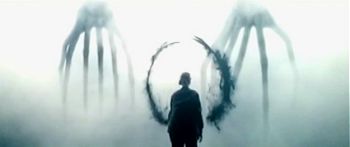
I was deeply impressed with the recent movie, "Arrival", which attempted to address this subject. As McKenna has said, if there are assumed to be intelligent extraterrestrial life forms, most likely they are so alien, we wouldn't possibly be able to comprehend their purposes or their agendas, let alone their modes of communicating or conveyence. The movie pivots around this point, and ultimately shows how our reality is shaped by language. In the movie, the visitors defined human language as "a weapon", possibly due to it being so limited that it was harmful to comprehend it. Conversely, the contact human, a linguistics expert interacting with the aliens, was completely transformed by attempting to comprehend what the aliens were actually using as their mode of communication.

As standard operating behavior and habit, we interpret our experiences as words. The feelings, deeper perceptions we have about the world are translated into words. We say it's because we want to understand these things and be able to report to others about them. But this is really more of an excuse not to simply BE without words, and use our capacity to know outside of understanding. If we are filtering everything with the language we use to interpret it, how much of it is not covered by words, and so is lost?

One of the exercises I was taught by my guru many years ago was the practice of non-duality. In this practice, we try to see the world and our experience of it as a whole system containing both ends of a spectrum or duality. Say we witness what appears to be a cruelty in the world. The non-dual approach would be to simultaneously notice the kindness resulting from the cruelty. We try to see hate as a cry for love; a judgment as a desire for something greater. After practicing this for awhile, you come to a place where language seems limiting--indeed a "weapon" of limitation, secrecy and control.

Even in the "new age" spirituality movement there can be a "weaponizing" of spiritual concepts by using them to belittle, invalidate or limit another. Your 4th Chakra is closed down, so you are a hateful person, for example. The non-dual version would be the observation that the person's 4th chakra is in the process of opening as indeed is the entire being.

Because our world is made of language, we can use it to define our lives in a more constructive and generative way, by simply repeating the words to construct the life of our dreams. In light of the dualistic nature of language, the task becomes one of disciplined mindfulness: observing the negative thoughts as openings to a reality without that negativity--using the negativity itself to build a positive, life-affirming, generative life full of purpose, joy and ease.

Tune in to the oneness. It is emanating from every point in the Universe.

Thursday, May 4, 2017

Building a Ladder to Infinite Possibilities

creator One of the more amazing aspects to Life that quantum physics teaches us is that all possibilities--infinite possibilities--exist within every moment. We also learn that the subatomic intelligences making up the perceivable universe(s) are clumped together in forms that the mind assigns use and meaning. These subatomic intelligences are listening to our thoughts and watching our actions at every moment.

In the science of epigenetics, we find that the decisions, opinions, fears and other emotional states not only create gene expression, which changes DNA, but that these changes are passed down for generations unless acted upon or changed.

The way we view life--our Point of View--sets up a matrix within which the subatomic intelligences build their forms and sequences. By changing your conclusions about Who You Are, it changes the matrix, and thus changes the forms surrounding you.

Most of what makes up our lives are the conclusions and points of view we established about what we perceived as events that happened around us. These conclusions and points of view direct the activities of subatomic particle-waves. Unfortunately, because we are habitually inclined to conclude and judge what we see and feel, we end up inadvertantly doubling down on our situations, creating unchanging conditions, stagnation and premature death.

The way out of the conundrum of reinforcing fixed or stubborn conditions is to stop judging, stop concluding, and stop habitually asserting a particular point of view. Instead, ask questions.

The question is the signal to the subatomic intelligences to change their positions in the matrix of Self. When you allow your perceptions, but then do not judge or draw conclusions about them, it opens up the energy and space for change to occur. By "staying in the question", you "loosen" tight, fixed forms and start to allow new energies and new forms to come into being.

possibilities How do you stay in the question? The key is mindfulness. We must be able to observe the moment we "double-down" with a conclusion or point of view. For example, your employer passes you up for a well-deserved promotion. The conclusion? "It's unfair!" or "I'll never get anywhere at this place", or "I guess I'm just not worthy". Instead, ask the question, What else is possible? What about this is getting me to my greatest and most glorious life?

Now, by asking questions, the secondary habit is to suddenly receive an awareness or a perception or "answer", and then make that answer a conclusion about "how things are". This is where mindfulness comes in again. Instead of making these answers into conclusions, simply ask more questions. The goal is to remain in a state of "ask" at all times. By attempting this, you'll become acutely aware of the debilitating and limiting conclusions and judgments you're making about your life. And sometimes it ain't pretty.

Every time you replace a conclusion with a question, you've added a rung to the Ladder of Infinite Possibilities, allowing greater space, greater vision and higher awareness than you had before. Ultimately, you're climbing into your infinite life, packed full of potential and possibilities for realizing the life you truly desire to live.

Friday, October 7, 2016

Are You Living A Story You're Not Aware Of?

blinders Lately I've been paying attention to what story I've been living. You'd think it would be obvious, just by looking around my life and noticing the patterns. But that doesn't account for habits of perception, and blind spots.

What I mean by "habits of perception" are packaged conclusions you've made that amount to preconceived ideas about the "way things are", or the "way things should be". These are judgments and points of view, that can be changed, provided enough mindfulness is employed.

These preconceived "lessons" we've "learned" from life can create blind spots of assumptions. For example, just today I spotted myself commenting, "Well, I better get busy, or I won't make any money this month." This gem is chock full of assumptions about how money comes to me, or "how the world works"--you gotta work hard to make money. We just sort of off-handedly live by these "rules", when they are based almost completely on incorrect conclusions made when we were much younger, and less wise. Yet, here we are, spouting these life rules without any critical thinking or regard to their veracity.

String enough of these rules together, and they form a narrative--a story of our life and how it unfolds for us. The thing is, it's based almost entirely on past conclusions, judgments and points of view. The fact that, in many cases, the story has been proven unworkable and sometimes miserable, doesn't seem to cause any introspection. Why? Because it's all tangled up in who and what we believe we are.

We've come to believe (because we've accepted certain things as "true"), for example, that "nothing comes easy for me." And, even when something DOES come easy, there is no alarm or red flag to tell us that our little story about how nothing comes easy has just been contradicted. Instead, we ignore that information. But when corroborating evidence that things don't come easy arrives, we are quick to jump on it as definitive evidence of the "truthiness" and consistency of our story.

reframe This selective awareness or filtering of evidence we use to justify our precious stories, is also the way we can change a story we do not want to live in anymore. Just as we ignored exceptions to the "rule" (that nothing comes easy, for example), we can now notice the exceptions and make THAT the evidence that our story is changing. Once we make ONE exception the rule, it all starts to shift. The trick is being able to SEE evidence contradicting our stories.
One way to increase mindfulness is by using gratitude. We are grateful for what we have, and grateful when things "come together" with ease and joy. Without gratitude, we would tend to simply overlook these moments of ease and joy because they contradict our ongoing narrative (that life never comes easy).

Another technique is to "re-frame"--where we re-contextualize what we are experiencing into a positive narrative. For example, when I'm in a hurry to get somewhere--I may be under some sort of deadline--and traffic seems so slow, and that street is blocked off for a festival, or there's a tree down in the road--I would immediately jump to this being evidence of how HARD things are, and nothing comes easy. Instead, by re-framing I become grateful for these slow drivers who are timing my travels so I won't get into an accident in my haste.

In these ways, we can get out in front of our story, and make whatever changes we choose about how the story unfolds.

A long time ago, my guru told me, "Do you know how to train a cat? You wait until it does something you want it to do, and then reward it." Life is much like that--it's flowing according to the story you're creating, and will immediately change course if you do. Change course with gratitude and re-framing.

Tuesday, March 1, 2016

Predicting and Choosing

routine I love those moments when "out of the blue" you get an insight on how you've been living your life--and they seem to come when I'm doing something mundane, like walking the dog, driving the car, or grocery shopping (must be some neurological circumstance of some sort)... Anyway, today a big existential question came crashing in: "Do I really know what's going to happen, or am I choosing it?"

Now, what I mean by "knowing what's going to happen", is a range of things--from daily routines where you pretty much know what's going to happen when you take a shower, or do the dishes--to knowing where the money is going to be coming from to pay the rent. In fact, all those circumstances that you just know are going to happen, and do, make up the matrix of our lives; and we don't often stop to see all the choices we make moment by moment to keep that matrix rolling along.

The quantum truth of the matter is that ANYTHING could happen AT ANY MOMENT, since quantum states exist in and out of time, which makes all possibilities possible at any time. I might think I know what's going to happen when I get in the shower, but then the water suddenly shuts off because the City workers turned off the water to the apartment while they repaired the broken main. Or, I think I know what's going to happen when I do the dishes, but then the garbage disposal jams...and I get all bent out of shape about it.

The point I'm attempting to make is that by habitually pre-determining our choices by making predictions about our own activities, shuts off the infinite other amazing possibilities that could happen. I think we construct a nice, predictable set of circumstances for ourselves that (we think) guarantees security for our reality (our money situation, our living quarters, or transportation, our relationships). But what if by doing this we unwittingly cut ourselves off from a huge potential of fantastically wonderful things that could happen to us?

actualization Perhaps a more "quantum" way to live would be to--instead of predicting what's going to happen--we just float in the question: "What amazing things await me at any moment?"
There have been manifestation experiments where it was shown that asking questions about something greater happening, is far superior to visualization techniques. In other words, jump out of the box of yourself and trust that the Universe has your back, and is going to give you what you desire. Your job is not to limit it to a specific set of familiar circumstances.

We have all been burned badly by the unpredictable, so the idea of asking open-ended questions about our desires feels like giving up our personal power, and control, and that is scary.

Gary Douglas, founder of Access Consciousness tells us to "live in 10 second increments"--where any choice can be changed within 10 seconds. Now that's freedom. You desire something? Get the energy of that thing--just the energy of what it feels like, not what it looks like--and keep choosing that, and follow the energy to the actualization of that desire.

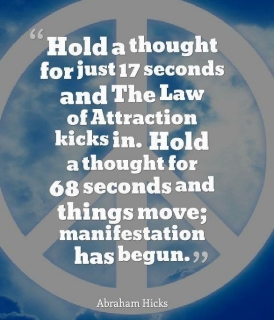
68 seconds Abraham Hicks has a famous saying: "Hold a thought for just 17 seconds, and the Law of Attraction kicks in. Hold a thought for 68 seconds and things move; manifestation has begun."

So, rather than "predicting" everything that's happening to you (thus guaranteeing the same old-same old), start choosing your desires by asking questions like, "What would it take for ______ to show up?" "What energy, space and consciousness do I need to be for __________ to happen?"

After a little practice, things really will start moving directly toward your desires, and if you stay out of the habit of needing to have a predictable life, who knows what fantastic things could happen?

Wednesday, February 17, 2016

Take A Moment

moment An article inspired me in this newsletter about joy not having to be an intense experience, and that cultivating an awareness of "okayness" is a valid path to well-being. In fact, unamplified states of gratitude and appreciation for the "little things" in life go a long way to de-stressing the system, and allowing the body and mind to restore.

I think it is a part of the human condition to strive for intensity of feelings; a way of creating a narrative of grandness and transcendence that rises above the "normal", the "mundane" or "average". It is born out of a numbness to routine, and a sort of blanking out of the repetitive or regular, much like retinal fatigue, or the numbness from rubbing an earlobe. Society's highest expectations and rewards are given to those living the most outrageous and intense lives, and we all have embraced this paradigm as a judgment on how we measure up. You know, the "star" factor.

Modern psychologists would chalk these attitudes up to bad mental health, and here's why: Most of what happens to us in our daily lives certainly is unremarkable, and yet we seem to measure our joy factor or happiness factor by how intense our perceptions are as we put a priority on extreme events.

We've all heard people say, "It was really dangerous, but I've never felt so alive." The reality of this is if this danger you speak of that was making you feel so alive just kept going without respite, the stress of it would certainly kill you.

dangerous Another aspect to this is finding fault with experiences, judging them as "boring" or "monochromatic" or "disappointing" in some way. It's a mind set that has an expectation of intensity that sets a standard against which all experience must measure up. This is validated with TV dramas, big movie adventures, and sweeping novels--all stimulating our nervous systems and exacerbating our sense of the extreme. Our lives by comparison certainly become dull.

Everything Science tells us about the human mind-body system is that excitement, danger, peak experiences, are all stressful to the body; causing the restorative systems to shut down, the adrenaline flight or fight systems to ramp up, leading to cell damage and oxidative stress injuries. The life of the adrenaline junkie is certain to be shorter and less satisfying over the long term.

As an alternative approach, start to become aware of these conditions:

  • At this moment, nothing hurts
  • Right now, I am not upset, and I'm not suffering
  • Nothing is actually bothering me at this moment
  • I don't really need anything right now
  • I'm fine with the way things are right now
  • I'm grateful for just being able to be
  • I appreciate everything around me at this moment
flower When you start breaking it down like this, it becomes apparent that what is really causing any of your well-being and any of your happiness is happening at every moment. Lifting all the judgments about how we're not living up some "superman" or "superwoman" intensity, allows us to become aware of and enjoy those small moments to ourselves, and allows these moments to rise to equal priority with moments of intensity.

I'm not saying one shouldn't strive for something fantastic in their life, or plan big adventures. I'm saying that the time between the intensities of life is just as valuable, if not more so in terms of body repair and mental well-being. We tend to forget that this is important amidst all the bombardment of MMA fighting, 200 MPH car races, super-hero blockbusters, acid trips and rock star stadium concerts.

Just take a moment, to have a moment.

Sunday, October 25, 2015

The Choice Trap

choice Our most powerful tool, choice, is also our most abused and unused. This basic mechanism of consciousness is the direct demonstration to ourselves of our power and powerlessness. Are we choosing the best life? Are we choosing to destroy it? Are we not making choices because we're afraid? Are we afraid of any choices at all?

These are really deeply existential questions that get at the core of what we are: creators. We create our life only by using choice. In fact, making choices is something so natural, so automatic, we oftentimes don't realize that we are choosing the pain, discomforts and unwanted conditions we "live with" on the day-to-day. We tell ourselves, "We have no choice" about this, that and the other.

I like to call this the Choice Trap. We pretend we're not choosing and things get bad or worse, and then we suddenly realize we "have no choice" but to...(fill in the blank). My spiritual teacher once told me, "Choosing is an exercise in paying attention. Be aware of what you choose, because it's the only way you're going to get what you want." At the time I laughed at this seemingly obvious statement, but later I realized it was quite profound. There are so many "choices" we make in the form of choosing to "go along" with others, or choosing to procrastinate, or choosing to not do what you know needs to be done, or choosing not to think about your life. These are, often times, unconscious choices that become a sort of operating manual for life.

We can too easily choose to be a victim, or choose to look outside ourself for causes, or choose to be "right" as opposed to "correct". In fact, most of our psychology is constructed on the choices we've made to embrace or deny our values. What's the more important choice? Being right or being compassionate? Being truthful or secretive? All of these types of questions point out what we are choosing any given day.

A friend of mine visited last week on vacation, and said, "It's been so nice to be on vacation. I don't have to make any decisions--I just go wherever I want and do whatever I want." To him, making a decision was a big deal, and yet he was making choices the entire time of his vacation as to where to go and what to do. He didn't think of these kinds of choices as being significant. And yet, these are the kinds of decisions that get us from Point A to Point B every day, and are the key to living the highest and best life we can imagine.

follow energy There are a couple of "choosing hacks" I like to use to keep me mindful of the choices I'm making moment to moment. One is, "light or heavy". Say you've narrowed your choices down to two. Ask the question, "is this light or heavy"? One of the choices will seem lighter than the other one, or if they both seem heavy, there is another unacknowledged possibility you aren't considering. If they are both feeling light, well, then, have fun! Always favor lightness. It will serve as your North Star for navigating through your day.

The second choosing hack is "follow the energy". This is similar to favoring lightness, but it's much more specific. Get the idea of something you want to have. Feel the energy of that as though you have it. Now, start choosing the things to do in your day or week that make you feel that same energy. Before too long, you will have that thing you originally wanted, and usually more. It's the "act as if" drill applied to energies.

So, carefully observe every time you make a decision, no matter how small or inconsequential. You'll begin to see where you've actually decided to have the life you have. And once that awareness dawns, you can change it by using your most powerful tool: Choice.

Wednesday, October 7, 2015

Two Tools

question There are two tools in Access Consciousness that I have found are absolutely great as what I call "anti-funkifizers". You know, when you feel yourself falling down in life, and beating your own head against a wall you are painfully aware you put there yourself. That kind of "funkify".

TOOL NUMBER ONE: Staying in the Question. Humans are not particularly good about handling answers. We tend to "find THE answer" and then stick with that sucker come hell or high water (even if we caused the hell and high water). I guess there is a sort of comfort in "knowing you have THE answer". And yet (and I speak from experience), when you think you've found The Answer, after some time and life goes by, you pretty much become convinced that it really wasn't THE answer. So you start off again down that road to the Holy Grail. It's in human DNA, I believe, and it's not very useful.

What IS useful, is to continually ask the open-ended questions and sticking with those no matter what happens. Questions such as, "What energy do I need to be to experience my life with ease and joy?" Or, "What else could happen here that is far beyond what I ever could imagine?" Or, "What would it take for me to be happy, creative and inspired?" In other words, you don't want questions you already know the answers to, or that have obvious answers. You're shooting for the moon with the questions, with no idea what the answers could be. In fact, you don't want to have answers, just better questions.

What's weird is when you ask questions like these, you begin to get certain awarenesses that look like answers. It's the "ask and you shall receive" mechanism in this reality. And it's nice, but you want something even greater. "What else is possible?" is a great question when you start getting "answers" or awarenesses as a result of an open-ended question.

What's also weird is that apparent answers or changes relating to the question start coming at you from the Universe at large. Someone will say something that relates to your question, or an event or scene will suddenly strike you as particularly relevant to your question. It's fun, really, and really helps restore your curiosity. Much less frustrating than burdening yourself with the search for answers. The Universe is much better at those. Let it do it's job.

point  of view TOOL NUMBER TWO: Interesting point of view. This is a very useful way to snap out of negativity of any kind, or to "reset" yourself when you realize you're being judgmental or making a bunch of conclusions not supported by evidence. Just say, "Interesting point of view I have that point of view." The self-observation that your behavior was the result of a specific point of view allows you to shift outside of it, and in so doing neutralizing the energy with that point of view. For example, I have late bedtime and late rising hours, and this morning someone was hammering on something next door. After waking up three or four times all grumpy about it, I remembered Interesting P.O.V. I made the statement a few times and lo and behold, I wasn't grumpy anymore, and was able to go back to sleep and not be awakened again by the noise. This is a good one for driving in traffic, too, or in any social gatherings or events. It keeps you light and in present-time awareness. Much more fun!

Experiment with the two tools, and who knows where you could go and who you could be?